
📚 Help Us Bring Stories to Everyone

Original price was: $13.99.Current price is: $5.00.

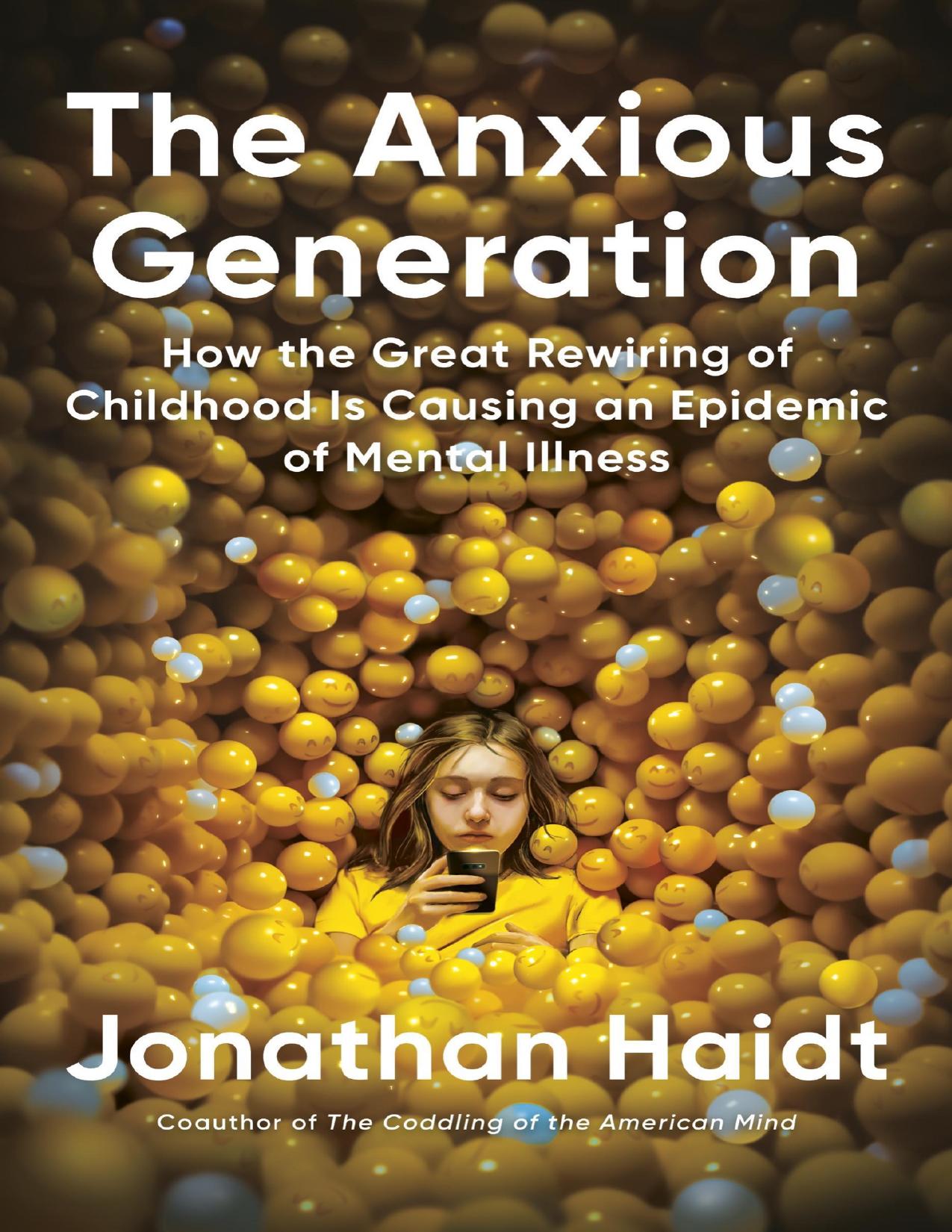
The Anxious Generation

The Anxious Generation by Jonathan Haidt is a groundbreaking investigation into the epidemic of youth mental illness, arguing that the shift from a play-based childhood to a phone-based childhood has fundamentally rewired young minds. Unlock the data and solutions behind today’s parenting crisis with Instant Digital Download in Premium Quality EPUB/PDF formats—available Exclusive to Noveliohub.

Share :

Description

The Anxious Generation

Introduction

Welcome to Noveliohub, your premier destination for premium digital reading. We are dedicated to bringing you the most talked-about and essential non-fiction titles in a superior digital format. Whether you’re seeking to understand the complexities of modern society or looking for personal growth, we ensure your next great read is just a click away. This exclusive edition of The Anxious Generation by Jonathan Haidt is available for instant digital download, offering seamless access on any device without the wait for shipping. Dive into one of the most important conversations of our time with the highest quality eBook files available on the web.

The Hook: The Great Rewiring of Childhood
Something shifted in the early 2010s. As millennials aged out of adolescence, a new cohort—Gen Z—entered their teenage years armed not just with flip phones for texting, but with smartphones loaded with a barrage of social media apps. In The Anxious Generation, renowned social psychologist Jonathan Haidt presents a compelling and urgent thesis: we have inadvertently engineered a catastrophic rewiring of human development. Haidt meticulously charts the statistical explosion of anxiety, depression, and self-harm that began around 2012, pinpointing the exact moment when “safetyism” in the real world collided with a lawless virtual frontier .

He argues that while parents became hyper-vigilant about stranger danger and scraped knees—depriving kids of the essential “antifragility” gained from free play—they simultaneously handed them a portal to a world rife with comparison, sleep deprivation, and social isolation. This book is more than a diagnosis; it is a deep dive into the four foundational harms of the phone-based life: social deprivation, sleep deprivation, attention fragmentation, and addiction .

Why Readers Love Jonathan Haidt
Jonathan Haidt is not just an academic; he is one of the few public intellectuals capable of bridging the gap between complex moral psychology and everyday life. A professor at NYU’s Stern School of Business and a named Time 100 Most Influential People honoree, Haidt has spent decades decoding the intuitive roots of our beliefs . Readers gravitate toward his work because he wields data like a scalpel but writes with the clarity of a novelist. Unlike polarizing commentators,

Haidt approaches the culture war over parenting and technology with a centrist, solution-oriented lens . His previous works, including The Righteous Mind and The Coddling of the American Mind, established him as a trusted guide through the minefields of tribalism and fragility. In The Anxious Generation, he moves beyond criticism to offer a pragmatic “life raft” for families drowning in the digital tide, making his analysis respected across political divides and parent-teacher associations alike .

Deep Dive: Themes, Style, and Audience
The Anxious Generation operates on two parallel tracks that converge in a powerful call to action. Thematically, the book explores the concept of “Safetyism vs. Antifragility.” Drawing on the work of Nassim Nicholas Taleb, Haidt posits that children, like immune systems, require exposure to manageable risk to grow strong . By over-structuring childhood and replacing real-world exploration with screen time, we have made an entire generation more brittle and less resilient to life’s normal challenges.
Haidt’s writing style is academic in rigor but accessible in tone. He avoids dense jargon, opting instead for memorable metaphors—most notably the contrast between the “play-based childhood” and the “phone-based childhood” . The book is deeply researched, referencing longitudinal studies and psychological surveys, yet it reads with the urgency of investigative journalism. It is not an anti-tech screed; Haidt acknowledges the benefits of connectivity but distinguishes between the dangers of addictive social media algorithms and the utility of basic communication tools .
Target Audience: This book is essential reading for parents of Gen Z and Gen Alpha who feel they are losing their children to screens. It is equally vital for educators trying to manage attention spans in the classroom, policymakers grappling with online safety legislation, and mental health professionals seeking a macro-level understanding of the youth crisis. If you have ever wondered why kids are sadder, more anxious, yet physically safer than ever before, this book provides the definitive answer.

The Noveliohub Premium Experience
When you choose to download The Anxious Generation from Noveliohub, you are choosing a superior reading experience tailored for the discerning digital bookworm. Why settle for compressed files or locked-down ecosystems?

  • Instant Access: No waiting for mail carriers. Your Premium Quality EPUB/PDF files are delivered immediately upon purchase. Start reading in seconds.

  • Universal Device Compatibility: Whether you prefer a Kindle, Kobo, iPad, or simply your desktop PC, our DRM-free files are designed to work flawlessly across all your devices. You own the file—no walled gardens.

  • Lifetime Access: Your purchase grants you lifetime download rights. Access your personal Noveliohub library anytime to retrieve your books, ensuring your digital collection is safe forever.

  • No Subscription Required: Unlike other platforms that hold your library hostage behind a monthly paywall, Noveliohub offers a clean, one-time purchase. Buy the book, keep the book.

Reading Recommendations
While The Anxious Generation is a standalone work of non-fiction, it serves as a spiritual successor to Haidt’s 2018 bestseller, The Coddling of the American Mind. We highly recommend reading both to fully grasp the cultural evolution from campus fragility to the broader teen mental health epidemic.
Additionally, if you appreciate Jonathan Haidt’s analysis, you will likely find value in Johann Hari’s Stolen Focus , which explores the erosion of our collective attention spans in the digital age, or Jean M. Twenge’s iGen , which provides the foundational sociological data on the smartphone generation that Haidt builds upon.

Conclusion: Your Call to Action
We are at a crossroads. The Anxious Generation is not a book of despair; it is a map out of the wilderness. Jonathan Haidt provides a clear-eyed, evidence-based plan for reclaiming childhood—from delaying smartphones to restoring free play and independence . This is perhaps the most important parenting book of the decade, and it arrives not a moment too soon.
Don’t just read the headlines about the teen mental health crisis; understand the mechanism behind it. Equip yourself with the knowledge to make informed decisions for your family and community. Secure your Premium Digital Download of The Anxious Generation by Jonathan Haidt today—only at Noveliohub.

Reviews

There are no reviews yet.

Be the first to review “The Anxious Generation”

Your email address will not be published. Required fields are marked *

Related Products

Limited Time Offer

Get up to 50% OFF on Premium PDF Books Read more.

Testimonials

What Our Readers Say

Thousands of readers trust Novel IO Hub for quality ebooks and meaningful impact.
Here’s what our community says about their experience with our platform.

Introduction
GROWING UP ON MARS

Suppose that when your first child turned ten, a visionary billionaire
whom you’ve never met chose her to join the first permanent human
settlement on Mars. Her academic performance—plus an analysis of her
genome, which you don’t remember giving consent for—clinched her a
spot. Unbeknownst to you, she had signed herself up for the mission
because she loves outer space, and, besides, all of her friends have signed
up. She begs you to let her go.
Before saying no, you agree to learn more. You learn that the reason
they’re recruiting children is that they adapt better to the unusual conditions
of Mars than adults, particularly the low gravity. If children go through
puberty and its associated growth spurt on Mars, their bodies will be
permanently tailored to it, unlike settlers who come over as adults. At least
that’s the theory. It is unknown whether Mars-adapted children would be
able to return to Earth.
You find other reasons for fear. First, there’s the radiation. Earth’s flora
and fauna evolved under the protective shield of the magnetosphere, which
blocks or diverts most of the solar wind, cosmic rays, and other streams of
harmful particles that bombard our planet. Mars doesn’t have such a shield,
so a far greater number of ions would shoot through the DNA of each cell in
your daughter’s body. The project’s planners have built protective shields
for the Mars settlement based on studies of adult astronauts, who have a
slightly elevated risk of cancer after spending a year in space.
[1] But
children are at an even higher risk, because their cells are developing and
diversifying more rapidly and would experience higher rates of cellular
damage. Did the planners take this into account? Did they do any research
on child safety at all? As far as you can tell, no.
And then there’s gravity. Evolution optimized the structure of every
creature over eons for the gravitational force on our particular planet. From
birth onward, each creature’s bones, joints, muscles, and cardiovascular
system develop in response to the unchanging one-way pull of gravity.
Removing this constant pull profoundly affects our bodies. The muscles of
adult astronauts who spend months in the weightlessness of space become
weaker, and their bones become less dense. Their body fluids collect in
places where they shouldn’t, such as the brain cavity, which puts pressure
on the eyeballs and changes their shape.
[2] Mars has gravity, but it’s only
38% of what a child would experience on Earth. Children raised in the low
gravity environment of Mars would be at high risk of developing
deformities in their skeletons, hearts, eyes, and brains. Did the planners take
this vulnerability of children into account? As far as you can tell, no.
So, would you let her go?
Of course not. You realize this is a completely insane idea—sending
children to Mars, perhaps never to return to Earth. Why would any parent
allow it? The company behind the project is racing to stake its claim to
Mars before any rival company. Its leaders don’t seem to know anything
about child development and don’t seem to care about children’s safety.
Worse still: The company did not require proof of parental permission. As
long as a child checks a box stating she has obtained parental permission,
she can blast off to Mars.
No company could ever take our children away and endanger them
without our consent, or they would face massive liabilities. Right?
AT THE TURN OF THE MILLENNIUM, TECHNOLOGY COMPANIES BASED ON THE WEST
Coast of the United States created a set of world-changing products that
took advantage of the rapidly growing internet. There was a widely shared
sense of techno-optimism; these products made life easier, more fun, and
more productive. Some of them helped people to connect and communicate,
and therefore it seemed likely they would be a boon to the growing number
of emerging democracies. Coming soon after the fall of the Iron Curtain, it
felt like the dawn of a new age. The founders of these companies were
hailed as heroes, geniuses, and global benefactors who, like Prometheus,
brought gifts from the gods to humanity.
But the tech industry wasn’t just transforming life for adults. It began
transforming life for children too. Children and adolescents had been
watching a lot of television since the 1950s, but the new technologies were
far more portable, personalized, and engaging than anything that came
before. Parents discovered this truth early, as I did in 2008, when my two
year-old son mastered the touch-and-swipe interface of my first iPhone.
Many parents were relieved to find that a smartphone or tablet could keep a
child happily engaged and quiet for hours. Was this safe? Nobody knew, but
because everyone else was doing it, everyone just assumed that it must be
okay.
Yet the companies had done little or no research on the mental health
effects of their products on children and adolescents, and they shared no
data with researchers studying the health effects. When faced with growing
evidence that their products were harming young people, they mostly
engaged in denial, obfuscation, and public relations campaigns.
[3]
Companies that strive to maximize “engagement” by using psychological
tricks to keep young people clicking were the worst offenders. They hooked
children during vulnerable developmental stages, while their brains were
rapidly rewiring in response to incoming stimulation. This included social
media companies, which inflicted their greatest damage on girls, and video
game companies and pornography sites, which sank their hooks deepest
into boys.
[4] By designing a firehose of addictive content that entered
through kids’ eyes and ears, and by displacing physical play and in-person
socializing, these companies have rewired childhood and changed human
development on an almost unimaginable scale. The most intense period of
this rewiring was 2010 to 2015, although the story I will tell begins with the
rise of fearful and overprotective parenting in the 1980s and continues
through the COVID pandemic to the present day.
What legal limits have we imposed on these tech companies so far? In
the United States, which ended up setting the norms for most other
countries, the main prohibition is the Children’s Online Privacy Protection
Act (COPPA), enacted in 1998. It requires children under 13 to get parental
consent before they can sign a contract with a company (the terms of
service) to give away their data and some of their rights when they open an
account. That set the effective age of “internet adulthood” at 13, for reasons
that had little to do with children’s safety or mental health.
[5] But the
wording of the law doesn’t require companies to verify ages; as long as a
child checks a box to assert that she’s old enough (or puts in the right fake
birthday), she can go almost anywhere on the internet without her parents’
knowledge or consent. In fact, 40% of American children under 13 have
created Instagram accounts,
[6] yet there has been no update of federal laws
since 1998. (The U.K., on the other hand, has taken some initial steps, as
have a few U.S. states.
[7])
A few of these companies are behaving like the tobacco and vaping
industries, which designed their products to be highly addictive and then
skirted laws limiting marketing to minors. We can also compare them to the
oil companies that fought against the banning of leaded gasoline. In the
mid-20th century, evidence began to mount that the hundreds of thousands
of tons of lead put into the atmosphere each year, just by drivers in the
United States, were interfering with the brain development of tens of
millions of children, impairing their cognitive development and increasing
rates of antisocial behavior. Even still, the oil companies continued to
produce, market, and sell it.
[8]
Of course, there is an enormous difference between the big social
media companies today and, say, the big tobacco companies of the mid-20th
century: Social media companies are making products that are useful for
adults, helping them to find information, jobs, friends, love, and sex;
making shopping and political organizing more efficient; and making life
easier in a thousand ways. Most of us would be happy to live in a world
with no tobacco, but social media is far more valuable, helpful, and even
beloved by many adults. Some adults have problems with addiction to
social media and other online activities, but as with tobacco, alcohol, or
gambling we generally leave it up to them to make their own decisions.
The same is not true for minors. While the reward-seeking parts of the
brain mature earlier, the frontal cortex—essential for self-control, delay of
gratification, and resistance to temptation—is not up to full capacity until
the mid-20s, and preteens are at a particularly vulnerable point in
development. As they begin puberty, they are often socially insecure, easily
swayed by peer pressure, and easily lured by any activity that seems to offer
social validation. We don’t let preteens buy tobacco or alcohol, or enter
casinos. The costs of using social media, in particular, are high for
adolescents, compared with adults, while the benefits are minimal. Let
children grow up on Earth first, before sending them to Mars.
THIS BOOK TELLS THE STORY OF WHAT HAPPENED TO THE GENERATION BORN AFTER
1995,
[9] popularly known as Gen Z, the generation that follows the
millennials (born 1981 to 1995). Some marketers tell us that Gen Z ends
with the birth year 2010 or so, and they offer the name Gen Alpha for the
children born after that, but I don’t think that Gen Z—the anxious
generation—will have an end date until we change the conditions of
childhood that are making young people so anxious.
[10]
Thanks to the social psychologist Jean Twenge’s groundbreaking work,
we know that what causes generations to differ goes beyond the events
children experience (such as wars and depressions) and includes changes in
the technologies they used as children (radio, then television, personal
computers, the internet, the iPhone).
[11] The oldest members of Gen Z
began puberty around 2009, when several tech trends converged: the rapid
spread of high-speed broadband in the 2000s, the arrival of the iPhone in
2007, and the new age of hyper-viralized social media. The last of these was
kicked off in 2009 by the arrival of the “like” and “retweet” (or “share”)
buttons, which transformed the social dynamics of the online world. Before
2009, social media was most useful as a way to keep up with your friends,
and with fewer instant and reverberating feedback functions it generated
much less of the toxicity we see today.
[12]
A fourth trend began just a few years later, and it hit girls much harder
than boys: the increased prevalence of posting images of oneself, after
smartphones added front-facing cameras (2010) and Facebook acquired
Instagram (2012), boosting its popularity. This greatly expanded the number
of adolescents posting carefully curated photos and videos of their lives for
their peers and strangers, not just to see, but to judge.
Gen Z became the first generation in history to go through puberty with
a portal in their pockets that called them away from the people nearby and
into an alternative universe that was exciting, addictive, unstable, and—as I
will show—unsuitable for children and adolescents. Succeeding socially in
that universe required them to devote a large part of their consciousness—
perpetually—to managing what became their online brand. This was now
necessary to gain acceptance from peers, which is the oxygen of
adolescence, and to avoid online shaming, which is the nightmare of
adolescence. Gen Z teens got sucked into spending many hours of each day
scrolling through the shiny happy posts of friends, acquaintances, and
distant influencers. They watched increasing quantities of user-generated
videos and streamed entertainment, offered to them by autoplay and
algorithms that were designed to keep them online as long as possible. They
spent far less time playing with, talking to, touching, or even making eye
contact with their friends and families, thereby reducing their participation
in embodied social behaviors that are essential for successful human
development.
The members of Gen Z are, therefore, the test subjects for a radical new
way of growing up, far from the real-world interactions of small
communities in which humans evolved. Call it the Great Rewiring of
Childhood. It’s as if they became the first generation to grow up on Mars.
THE GREAT REWIRING IS NOT JUST ABOUT CHANGES IN THE TECHNOLOGIES THAT
shape children’s days and minds. There’s a second plotline here: the well
intentioned and disastrous shift toward overprotecting children and
restricting their autonomy in the real world. Children need a great deal of
free play to thrive. It’s an imperative that’s evident across all mammal
species. The small-scale challenges and setbacks that happen during play
are like an inoculation that prepares children to face much larger challenges
later. But for a variety of historical and sociological reasons, free play
began to decline in the 1980s, and the decline accelerated in the 1990s.
Adults in the United States, the U.K., and Canada increasingly began to
assume that if they ever let a child walk outside unsupervised, the child
would attract kidnappers and sex offenders. Unsupervised outdoor play
declined at the same time that the personal computer became more common
and more inviting as a place for spending free time.
[*]